





This post is also available in:
 Deutsch
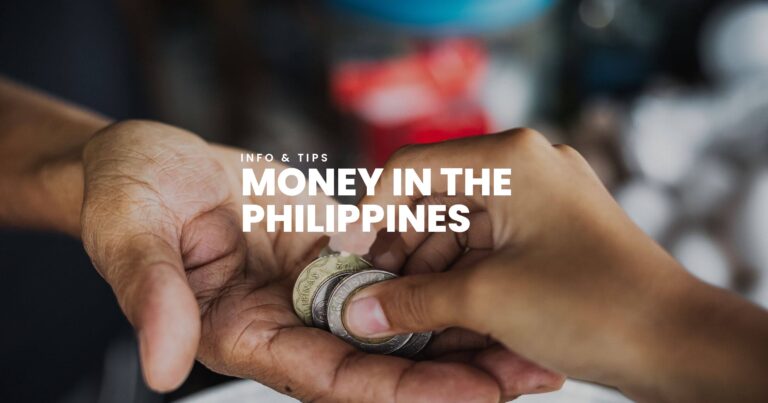
Welcome to the Philippines, a beautiful archipelago in the heart of Southeast Asia! Before you travel, you will almost certainly wonder how money works there. In this comprehensive guide we have put together how to withdraw and exchange money, plus other important tips on money in the Philippines.
Table of Contents
Money in the Philippines – The Basics
The currency of the Philippines is the Philippine peso, abbreviated as PHP. The peso is divided into centavos, which play almost no role in everyday life. The Bangko Sentral ng Pilipinas (BSP), the central bank of the Philippines, is responsible for issuing and regulating the national currency.
The Philippine peso has had its ups and downs over the years, and its value can fluctuate significantly against major currencies such as the euro or the US dollar. If you convert at a good moment, you can often get noticeably more for your money.
Banknotes and coins in the Philippines often show historical figures, landscapes and cultural motifs from the country.
- Currency: Philippine peso
- Abbreviation: PHP
- Symbol: ₱
- Subdivision: 1 peso = 100 centavos
Current PHP / Euro Exchange Rate
Currency Exchange and ATMs in the Philippines
In urban areas of the Philippines you will have no trouble finding currency-exchange offices and ATMs. Metro Manila and other larger cities such as Cebu are well equipped, so you do not need to worry about cash. Tourist areas in particular have plenty of exchange offices. Make sure you use money changers with official licenses and compare the rates so you get a fair deal. There are also currency-exchange facilities at every major airport in the Philippines, especially in Manila and Cebu.
ATMs are widespread, but it is wise to use only those in safe areas to reduce the risk of fraud. Also check the machine for tampering so your card details are not stolen (so-called skimming). ATMs in shopping malls and at banks are generally a safe bet, as security is usually present around the clock.
You can find a guide to withdrawing money in the Philippines here.
Tip: We recommend a Wise travel card*. With the Wise debit card you can spend and withdraw cash in the Philippines at the mid-market exchange rate, with free ATM withdrawals up to a monthly limit (then a small fee, depending on your country). That way you do not have to carry large amounts of cash, which is safer and reduces the risk of loss.
Card Payments in the Philippines
Paying by credit card is possible in more and more places. In hotels, shopping malls and restaurant chains in particular, paying by card is no longer a problem. Only in remote areas and small shops is cash the only option. Transport such as taxis, jeepneys and tricycles usually has to be paid in cash as well.
Money on Remote Islands in the Philippines
If you are on a remote island, ATMs may be limited. It is therefore wise to carry enough cash. Check the local situation in advance and plan your money accordingly. Some hotels and restaurants on islands may accept cash only, so be prepared. This definitely does NOT include Cebu, Boracay, Puerto Princesa, Coron or El Nido. We are talking more about rural areas, less-visited provinces and hard-to-reach island hideaways.
Update: Even in the south of Cebu (everything south of Moalboal) it can be difficult to get cash. On our last trip, local ATMs in the provincial towns and 7-Eleven stores (we tried a good 10 different machines) would not dispense money for foreign cards. Even though the ATMs clearly said they accepted international cards, we could not get cash from a single one of them. In Moalboal, Cebu City and Oslob, on the other hand, there were no problems at all.
Money and Safety
The safety of your money should be a top priority. That is why you should only carry the amount of cash you need. In busy places such as night markets, watch out for pickpockets. Avoid counting large amounts of money in public, and keep important documents such as cards, cash reserves and your passport safe at the hotel. Use the hotel safe whenever possible, as it can happen that staff take things.
Hold-ups are rather rare, but they can happen, especially in rougher parts of Manila. Jeepneys are also a popular target. If you are carrying larger amounts of cash, you should therefore always take a taxi — ideally one booked through the Grab app.
Tipping in the Philippines
In the Philippines, tipping is common and appreciated in many situations. In restaurants, a 10% service charge is often already included on the bill, which makes an extra tip unnecessary. Even so, a little extra is a nice gesture. For taxi drivers you usually round up the fare, while porters and hotel staff are happy with a small tip. It shows you appreciate the service and is a friendly gesture.
In restaurants, rounding up or around 10% of the bill is generally plenty. For tour operators and hotel staff you can give 100-500 PHP.
We hope these general tips on money in the Philippines are helpful, and we wish you a great stay. Enjoy your time in the country and do not worry about money — with these tips you will be well prepared!
Do you still have questions about money in the Philippines? Leave a comment!