






This post is also available in:
 Deutsch
The Philippines are a popular destination, whether you’re a beach lover, a backpacker or a business traveler. To stay reachable on the go and, above all, to get online at a reasonable cost, it’s a good idea to buy a local SIM card. In this article we give you an overview of mobile coverage in the Philippines, introduce the main providers and show you where it’s best to buy a SIM card. We also look at eSIM options and international alternatives.
Contents
Mobile coverage in the Philippines
Mobile coverage in the Philippines has improved considerably in recent years, which is especially good news for travelers. In urban areas such as Manila, Cebu or Davao in particular, the mobile network is well developed. In tourist regions such as Boracay or Palawan, you can also generally rely on solid coverage. In rural and remote areas, though — especially on smaller islands or in the mountains — there are still weak spots.
The mobile network in the Philippines is based mainly on 4G/LTE technology, and the rollout of 5G in larger cities is already well underway. For travelers that means you can usually get reasonably fast data in urban centers and tourist areas, while in remote regions you may only have 3G, or even just 2G or E.
Improvements in recent years
It’s important to mention that mobile coverage in the Philippines has improved a lot in recent years. Investment in infrastructure and competition among providers have made mobile internet faster and more reliable. Especially in metropolitan areas, travelers can now count on stable connections — something that, unfortunately, was often not the case in many places before the COVID crisis.
The main mobile providers in the Philippines
There are three major mobile providers in the Philippines that dominate most of the market: Globe Telecom, Smart Communications and the newer provider DITO Telecommunity.
Globe Telecom
Globe is one of the country’s largest providers and offers solid coverage in most urban and tourist areas.
Advantages:
- Good coverage in urban areas and popular tourist regions.
- Attractive data plans, especially for travelers who want to use social media.
- Regular promotions and bonuses when you top up.
Disadvantages:
- In remote rural areas, coverage is often weaker.
- Prices can be higher than those of other providers.
Smart Communications
Smart is Globe’s main competitor and offers similarly good coverage. In rural regions in particular, Smart can in many cases outperform Globe.
Advantages:
- Somewhat better coverage in rural and remote areas.
- Many flexible prepaid plans and promotions.
- Offers 5G in the major cities.
Disadvantages:
- In urban areas it can sometimes be slower than Globe.
- Customer service is considered less accessible.
DITO Telecommunity
DITO is a newer provider on the Philippine market and aims to challenge the competition with attractive prices and modern network technology.
Advantages:
- Very affordable prepaid plans and data offers.
- Modern infrastructure with a focus on 4G and 5G.
Disadvantages:
- Still being rolled out, so coverage in some regions — rural ones in particular — is limited.
- A smaller selection of plans compared with the established providers.
Data plans and prices
The cost of data plans in the Philippines is relatively low by international standards. Here are a few typical offers:
- Globe Telecom: Globe offers prepaid data plans from about €5 (300 PHP) for 3 GB of data for 7 days. Larger plans, such as 10 GB for 30 days, are around €15 (900 PHP).
- Smart Communications: Smart has similar prices, for example 3 GB for 7 days also at about €5 (300 PHP). Larger data plans with 10 GB for 30 days cost around €13 (800 PHP).
- DITO Telecommunity: DITO attracts customers with especially cheap offers, such as 25 GB for 30 days for only about €10 (599 PHP).
In principle, plans and offers always differ and can change. It’s best to check the providers’ official websites before you choose a plan.
Where to buy SIM cards in the Philippines
SIM cards are very easy to get in the Philippines. Travelers can buy them in various places:
- At the airport: Right at the airport, in both Manila and Cebu, the major providers have stands where you can buy a SIM card on the spot. Prices here are usually a little higher, but you have a working SIM immediately.
- In town: In cities you can buy SIM cards at regular prices in many small shops, kiosks or large shopping malls. There are often special promotions or bundles with data plans as well.
- Convenience stores: Nationwide convenience stores such as 7-Eleven or Ministop also sell SIM cards, often right at the checkout.

Registration and validity
Since 2023, SIM cards in the Philippines have to be registered under a new law, including for tourists. After you buy a SIM card you can register it either at the sales stand or online with the provider. You’ll need an ID document (passport) and personal details. Registration is usually quick and straightforward.
A SIM card used by a tourist generally stays active for 30 days, but can be extended by topping up and using it again. After 90 days of inactivity the SIM is normally deactivated.
Alternatives: eSIMs and international SIM cards
If you want to arrange a SIM before you travel, or stay flexible during your trip, eSIMs are an interesting alternative. Especially on a tour through Southeast Asia, eSIMs can be the better solution. We can recommend the following providers from our own experience.
DrimSim
DrimSim* is an international eSIM that works in many countries, including the Philippines. The price per MB is generally low, which makes it ideal for travelers who only need data occasionally or often move between countries.
Advantages:
- No tie to one provider or long-term contracts.
- Low data prices per MB, especially if you use little data.
Unfortunately DrimSim has no data flat rate; usage is billed per MB, which can get very expensive if you use a lot. Although prices are around 6 cents per MB in the Philippines, streaming a movie would cost around 60 euros.
In our view, DrimSim is therefore only for travelers who use their phone very little, or who rely on local Wi‑Fi and only occasionally look up information on the go that isn’t data-heavy.
Yesim
Yesim* offers eSIMs designed for individual countries or regions. For the Philippines you can choose from various unlimited data plans, which makes it a flexible option for heavy users. The unlimited data is the special feature here, because you can stay online without limits and use services such as Google Maps, Netflix or YouTube throughout.
Advantages:
- Country- or region-specific data plans with various volume options.
- Very easy setup and switching of countries and plans through an app.
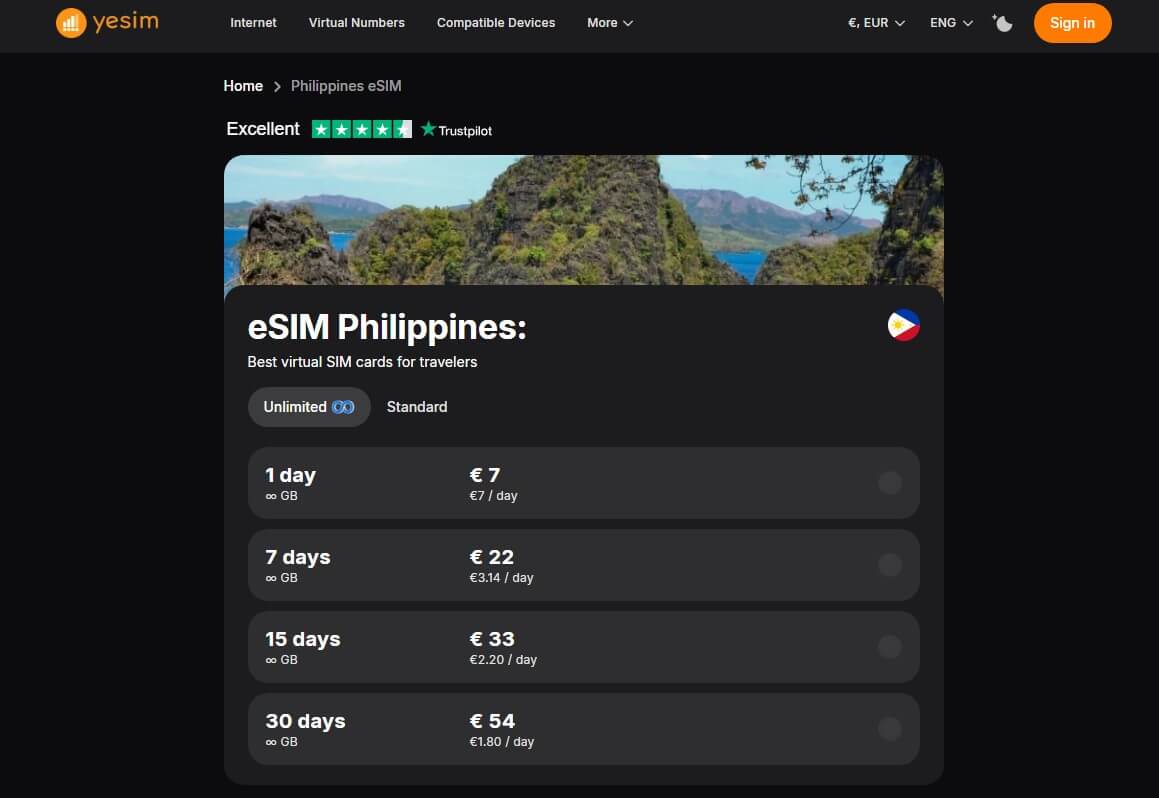
Yesim has fixed unlimited plans whose prices are actually not bad at all. Especially if you’re traveling through many countries and don’t want to buy a new local SIM every time, Yesim is a good option. These are the current plans for the Philippines:
- 1 day: €7 / Unlimited
- 7 days: €22 / Unlimited
- 15 days: €33 / Unlimited
- 30 days: €54 / Unlimited
In the Philippines, Globe is used as the provider.
SIM card Philippines — Verdict
There are many ways to stay online on a trip to the Philippines. Whether you go for a local SIM from Globe, Smart or DITO, or prefer the flexibility of an eSIM from DrimSim or Yesim* — you can be sure you’ll be online in the tourist areas whenever you need it. Just keep in mind that prices at the airport are a little higher, while you’ll find cheaper offers in town or at convenience stores.
Still have questions or tips about SIM cards in the Philippines? Leave a comment!